📍 Puerto Morelos, Mexico
The Emotional Power of Black and White Underwater Photography
Today, I want to share a striking image I captured at Ojo de Agua in Puerto Morelos—a moment where light, shadow, and the quiet weightlessness of water come together to create something truly otherworldly.
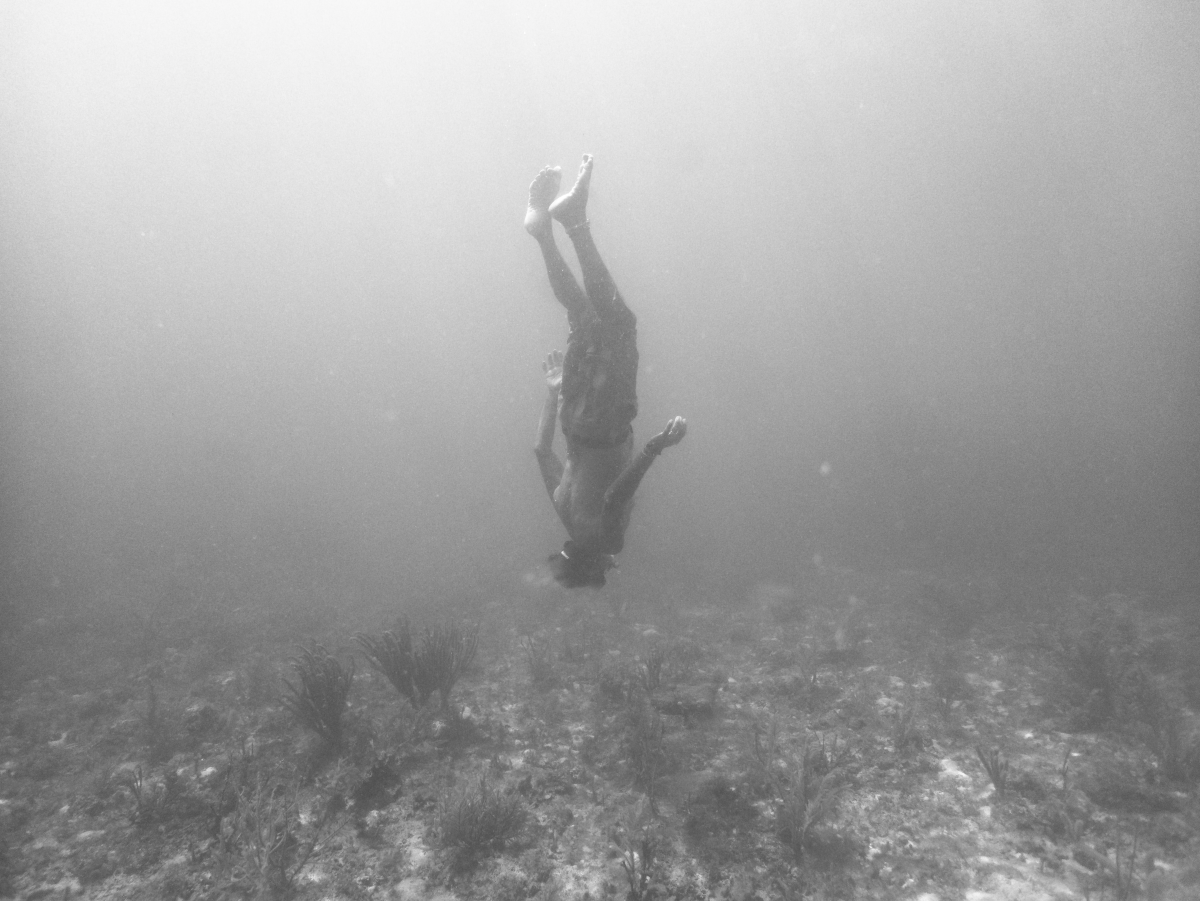
The photograph shows a diver suspended in a dramatic, head-first descent toward the seafloor. Rendered in black and white, the scene takes on a timeless, almost dreamlike quality. The misty water softens the space between surface and bottom, while a gradient of grays pulls the eye downward. Below, the rocky, coral-covered floor anchors the image with texture and weight.
There’s something uniquely powerful about black-and-white underwater photography. While color reveals the vibrant life of a reef, monochrome strips the scene to its essence—form, texture, light, and shadow. In this image, the diver becomes nearly abstract: a silhouette suspended between two worlds, forming a strong vertical line that guides the viewer through the frame.
Camera Settings & Capture
Technically, this image was built around controlling contrast and silhouette at the moment of capture. I shot with a fast shutter speed to freeze the diver cleanly against the softer water column, preserving the crisp outline of the body while allowing the background to fade into atmospheric blur. A moderately wide aperture helped isolate the subject from the surrounding environment, while still retaining just enough detail in the reef below to create visual grounding.
Exposure was biased slightly toward protecting highlights near the surface. That choice ensured the brightest parts of the frame kept their structure, allowing the darker water and seafloor to fall naturally into shadow. This is critical for black-and-white work, where blown highlights immediately break the illusion of depth and mood.
Natural light did most of the heavy lifting here. Rather than overpowering the scene with strobes, I leaned into the way the cenote light filtered downward, creating that soft gradient from bright to dark that gives the image its vertical pull and sense of descent.
Black & White Conversion & Post-Production
In post-production, the black-and-white conversion was handled with intention, not as an afterthought. Instead of simply desaturating the image, each color channel was carefully shaped to control how different tones translated into grayscale. Water, skin, and rock all respond differently in monochrome, and balancing those relationships is what gives the image its depth.
Local contrast was selectively enhanced using subtle dodging and burning—brightening the water column just enough to guide the eye downward, while gently deepening the shadows around the diver’s form to strengthen the silhouette. Texture was brought out in the coral and rock using restrained clarity, while the upper water column was kept soft to preserve the misty, dreamlike quality.
Grain was added very lightly at the final stage—not to mimic film for nostalgia’s sake, but to unify the tonal transitions and give the image a tactile, organic finish.
Why Black and White Works Here
The absence of color intensifies the emotional impact. Without the familiar blues and greens of the underwater world, the mind shifts its focus to contrast, balance, and atmosphere. The inverted posture of the diver adds to the surreal tension—at once graceful and vulnerable, human and elemental.
The gradual fade from light to darkness deepens the sense of mystery, while the rough detail of the coral and stone below grounds the image in reality. It’s this interplay between the ethereal and the solid that gives black-and-white underwater photography its quiet power.
Ojo de Agua offered the perfect setting for this kind of visual storytelling. Its crystal-clear cenote waters allow light to carve space in dramatic ways, revealing silhouettes that feel almost sculptural. Sometimes, removing color doesn’t take anything away—it distills the image to its pure emotional and visual core.
Comments (0)
Log in to leave a comment.
No comments yet. Be the first to comment!